

The Big Bang
In the beginning, 13.8 billion years ago, the Universe is pure energy, perfect, symmetrical, and transcendent of space and time. Then, like an ocean wave finally meeting the rocky shore, this energy crashes into existence, shattering into myriads of tiny droplets. In a flash, the Universe is born. The droplets are the fundamental particles, matter of all vibrations. These energetic chords cascade through a chaotic cacophony as the Universe expands and cools, settling on lower and lower energy notes until the base notes, the lowest energy states we know as “ordinary matter,” prevail. What emerges form the chaos is a Universe of light and air. As matter cools and whooshes in every direction, the bright light begins to fade beyond what is visible to eyes. The Cosmos is full of nothing but great clouds of Hydrogen gas, swirling in darkness …


The First Stars
The starless Universe exists as Hydrogen in the Cosmic Dark Ages for millions of years. As the Universe expands, the gas swirls and dances with the left over energy of the chaos it emerged from, forming nebulous clouds that grow colder as existence marches on through the darkness. Swirls of every size play in the mist, moving like smoke in a still room. The smallest swirls, minuscule compared to the mother nebulae, succumb the pull of gravity, turning their playful whirling into a violent plunge.
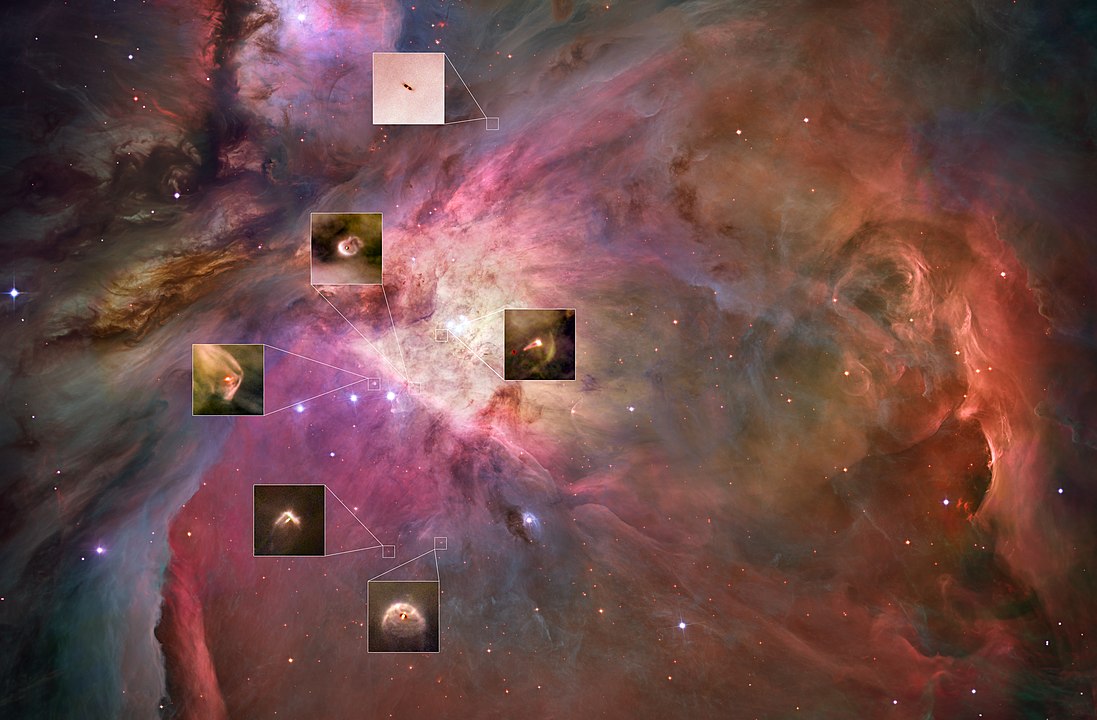
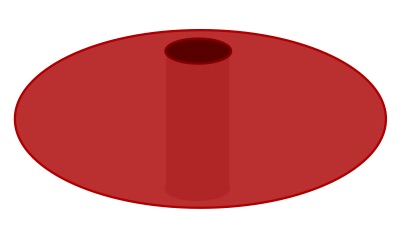
These vortices, crushed under their own weight, collapse to be denser and denser, becoming disks spinning faster as they pull inward. The once cold gas heats up in this energetic chaos wheel, becoming so hot it begins to glow. The gyres spin and spin, getting faster, hotter, and denser, until, when they are hot and dense enough, a nuclear fire ignites in the heart of each celestial cyclone. The first stars burst into brilliance a million times brighter than our Sun, and thus the Cosmos is sprinkled with the first constellations.

Black Holes
The first stars are made of nearly pure hydrogen and are huge, brilliant beings far larger than our Sun. They embody the phrase “live fast, die young,” quickly burning up their nuclear fuel and ending their lives in enormous explosions after only a few million years.
A few million years is long compared to our lifetime, but only the span of a single bead on the string. Our Sun, on the other hand, is expected to live for ~10 billion years, a majority of the length of the bead string.
These stars are crucibles of creation. In the nuclear fires of their intense innards, these astral alchemists turn the light hydrogen into heavier and heavier elements. As the stars burn, these heavy elements sink deep into the star until iron, the heaviest element the star can handle, the soot of nuclear fire, begins to build up in its heart. This iron heart is the death of large stars. Mere minutes after it’s formation, the star falters as its enormous weight collapses the iron heart, crunching it like a giant atom-smasher and causing an event we call a supernova. In this brief moment, the flash outshines billions of neighboring stars combined. So much energy is released that the outer part of star explodes into space, but what was once the star’s heart remains. It is now an object of pure energy, matter compressed to be so small that it is a mere pinprick in size compared to the once great titan. The heart has transformed into a black hole. Thus, the first constellations start to crackle like fire crackers as new titanic stars form and die with the scintillating roil of the Universe.
These black holes are doomed to wander the Universe under the cover of darkness. They are silent and invisible in their journey except when an unfortunate star falls in their path. The star may be many thousands of times bigger than the black hole, yet it is ripped and shredded into a blazing disk before being consumed in its entirety. The black holes grow as they consume stars and nebulae, sometimes merging with other black holes and sending gravitational ripples through spacetime as they spiral into one another. In the young Universe, these black holes eat often, and some grow to be true monstrosities…
The First Galaxies
With the passage of time, the Universe is lit up with more and more stars, and the gaseous expanse is increasingly wracked with shockwaves from more frequent supernovae. The gas and stars are constantly pulled together by gravity, and the beginnings of the first galaxies form as stars and gas swirl together in bright bunches all across the cosmos. Theses small galaxies are constantly buffeted by great clouds of fresh gas flowing inwards, and pummeled by collisions with other small galaxies.

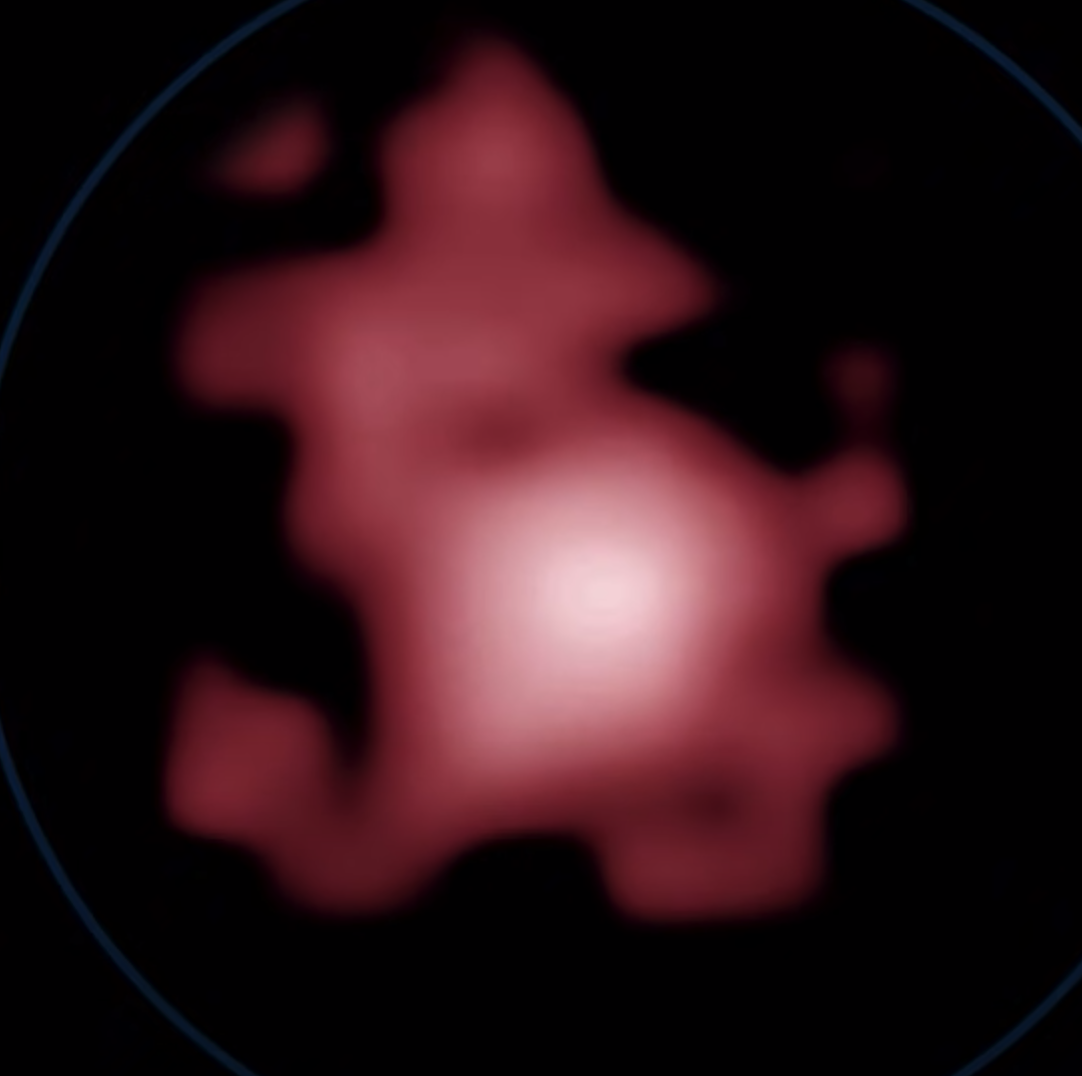
This bead represents the furthest galaxies that our current telescopes can detect. They appear as little more than pixelated blobs when viewing them from billions of lightyears away. Because the Universe has expanded considerably since the light began its journey to us, we find it stretched into longer wavelengths, turning it red, a phenomenon known as cosmological redshift.

Quasars

As the early scattered galaxies grow, they roil with the births and deaths of thousands of stars within. The deaths of large stars are the births of black holes, and thus there are soon thousands of them marauding within each galaxy. Though incredibly tiny, the black holes have a large influence on all the starstuff around them. As many more black holes form and grow, it becomes a dogfight of gravitational beasts vying for dominance. As they eat and merge, they become the gravitational ringmasters of more and more stars. The very largest eventually situate themselves as cosmic kings seated in the middle of great hoards of stars, the very center of galaxies. Over hundreds of millions of years, the largest grow to be a billion of times the mass of the Sun, a galaxy’s worth of stars all in the belly of one dense object.
Nearly all large galaxies have a central supermassive black hole, including our own in the direction of the constellation Sagittarius.
The warped darkness of these black holes’ event horizons may be as large as the solar system. As these monsters eat stars and gas that stray too close, enormous glowing storms happen in a blazing ring around the black hole as the material is shredded and accelerated to nearly the speed of light. Two energy beams burst out the north and south poles like gigantic cosmic laser canons ionizing everything in their path for hundreds of thousands of lightyears.

Composite image of radio, visible, and x-ray light[3]
When pointed directly at us, these energy beams we call quasars are the brightest things in the Cosmos. This is why we can see them even though they’re billions and billions of lightyears away, nearly on the edge of the Observable Universe.

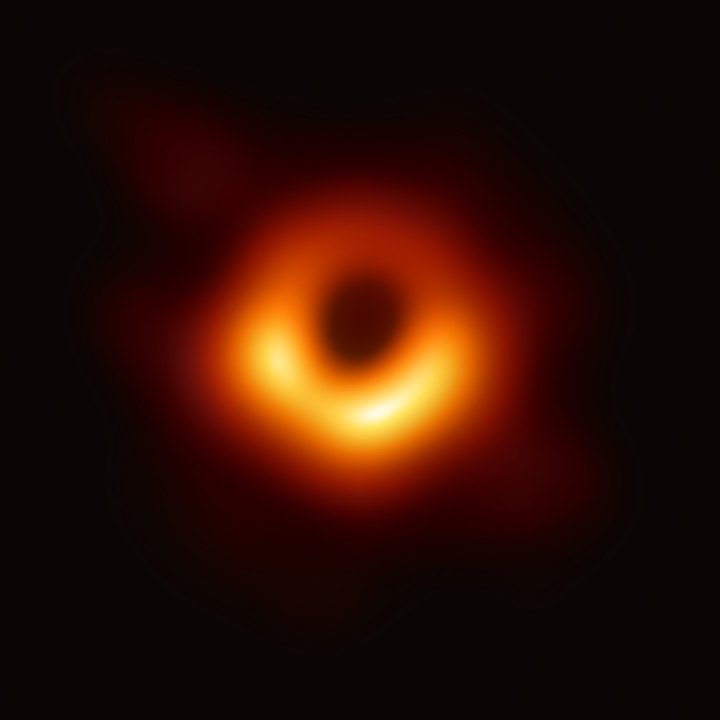
These supermassive black holes lurk in the depths of galaxies for ever after, only incrementally growing larger whenever they catch a snack. When they are not actively eating, they are totally invisible, slumbering beasts awaiting their next meal for millions of years on end.

Beginnings of the Milky Way
As more galaxies form out of the great expanses of gas, the ancestors of our own galaxy are born. First, there are a few small neighboring galaxies that dance together, and, over time, are drawn towards one another. They eventually merge one by one to form a larger, more magnificent body of stars and gas. Each merger of these little galaxies triggers a flurry of star formation as their nebulae collide, stirring up the swirling eddies that birth swarms of new stars.

a clump of old stars embedded within our galaxy
Stars from this era still exist in the Milky Way today. They are so old that most of the fairly modest, slowly burning stars once resembling our sun have exhausted their fuel and blown off their outer layers, leaving behind a hot, dense, planet-sized star we call a white dwarf. These objects no longer burn with nuclear fusion, but instead simply glow with the leftover heat, growing cooler and dimmer over a staggeringly long time. Most of these ancient, ancestral stars live in the far reaches of the galaxy, appearing as a subtle a haze engulfing the Milky Way’s disk.

and its diffuse halo of old stars
Spirals
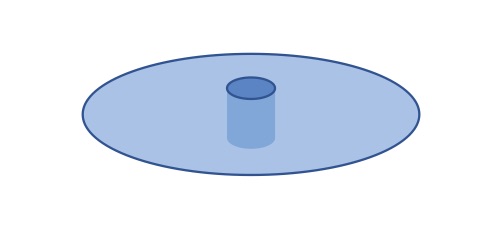
Small, early galaxies are too chaotic to have much structure, but, as they join and grow larger and more difficult to perturb, they stretch and flatten out into great spinning disks, like pizza dough. As more and more matter collects into the galaxies, the stuff between them is spread thinner and thinner by the expansion of the Universe. The pummeling of new gas and galaxies slows to a trickle, and the galaxies become like glowing islands in vast oceans of void, conjuring and consuming tendrils of new gas out of the ether like the wisps of sugar that make a fluff of cotton candy.
The galaxies settle as they finally get a chance to spin uninterrupted, and, over time, the various pulls of the stars on each other pull the whole galaxy into resonant, traveling, spiral waves. The individual orbits of stars pass in and out of these waves, but, as they do so, the stars and gas are squeezed together, triggering new star births. The spiral waves travel so slowly that the brightest stars explode by the time the wave has entirely passed, resulting in a glowing trailing edge rich in bright young stars. Thus, spiral arms travel through the disk like a scythe, harvesting fertile gas clouds for their fruits of new star systems. The ripest of these fruits then burst, sowing the the seeds for the next generation of star systems in their wake.
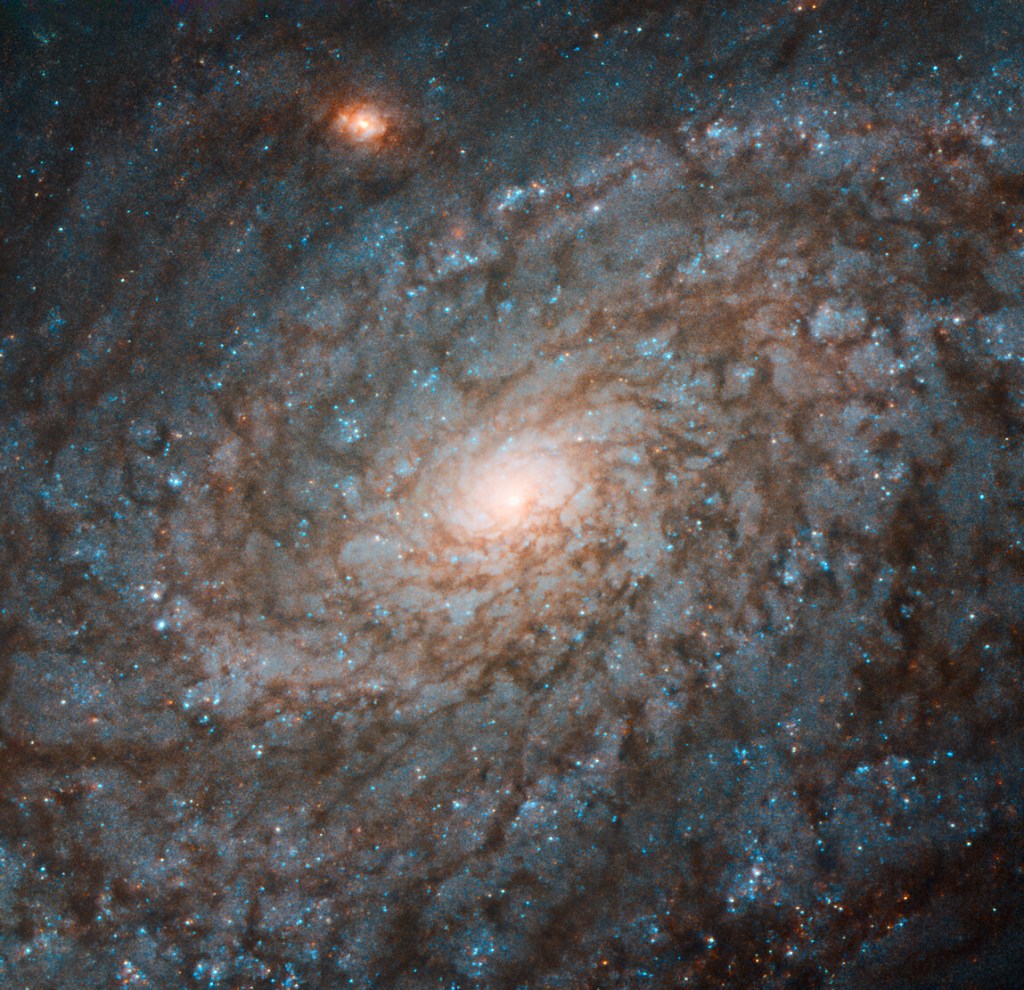
This bead marks the earliest galaxies we can make out as spiral with the Hubble space telescope, launched in 1990. The James Webb Space Telescope, launching in December of 2021, will be able to see much farther and in much better resolution. Its discoveries will likely shift this bead’s placement in time along with many others. Our knowledge of the Universe, like life or the Universe itself, is a dynamic, forever evolving thing.

Rocks
The first generations of stars were almost entirely formed of pure hydrogen, because all that existed in the early Universe was the lightest of gases. There were no rocks, dust, or ice around because the heavier elements that make them up, silicon, oxygen, carbon, etc. had not yet been forged. These elements first come into being inside the bellies of stars and stay thoroughly locked away in those celestial crucibles until they burst, spewing these elemental riches across the Cosmos.

With every nova, each star emptying its elemental innards makes the Universe dustier and dirtier. Eventually, new nebulae are sufficiently sprinkled with heavier elements that, when new stars form, the very first rocks and planets form along with them. Soon, most of the stars in the Universe start harboring little planet companions. Solid ground, liquid oceans, and life all become possible for the first time.
Each element, with its unique energetic arrangement of electrons, has a distinct pattern of colors it can absorb or emit. By carefully analyzing the particular rainbow of light given off by stars and galaxies, it’s possible to find out what elements they contain, despite being so very far away.

Cosmic Noon

The Universe enters a glorious age. Much of the gas has had the time to be drawn to and become a part of beautiful spiral galaxies. Young, fertile, and blue, these galaxies are rich in gas and peaceful enough to cradle great nebulous stellar nurseries where thousands of stars are born at a time. It is Cosmic Noon, the period of the highest rate of stellar births the Universe has ever seen or will ever see again.
The birthdays of the majority of the stars ever born in the heavens date back to around this period. All the stars born for the rest of time may never outnumber them.
The bountiful galaxies of the era dance around one another and often collide. With every encounter, a starburst of new stellar births ensues. The enormous collisions shred the spiral structure of the parent galaxies, and, having used up most of their gas and thrown off much of the rest, the resulting galaxies mostly retire from star formation.
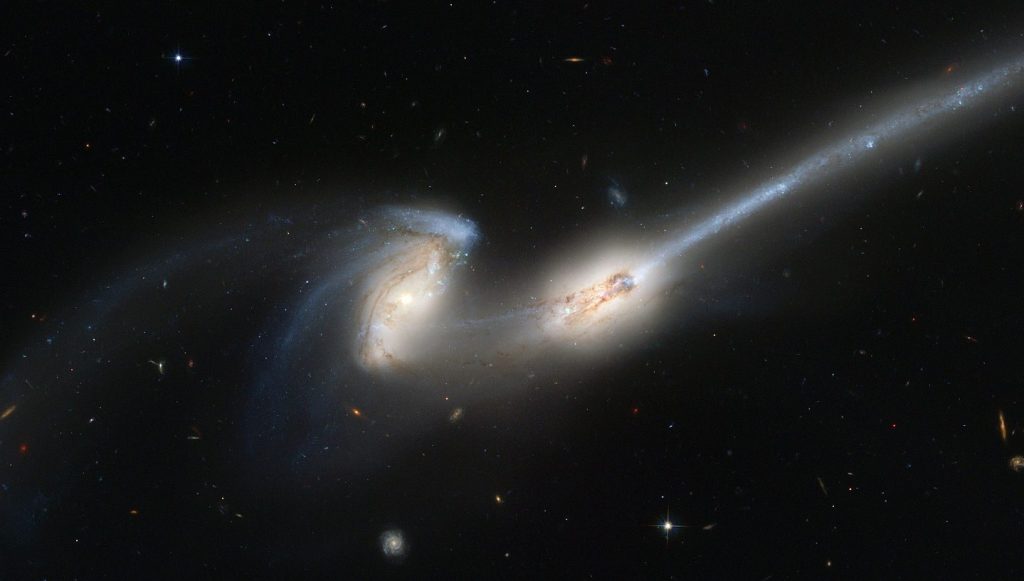
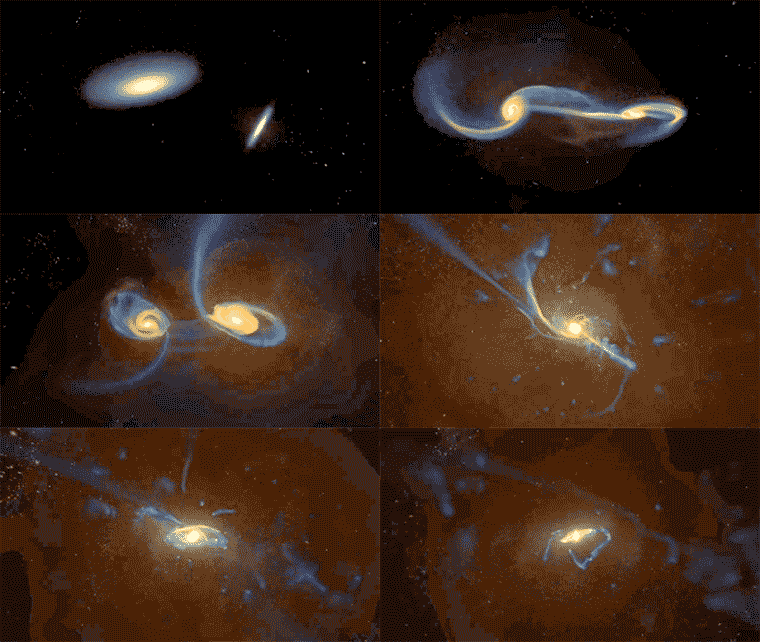
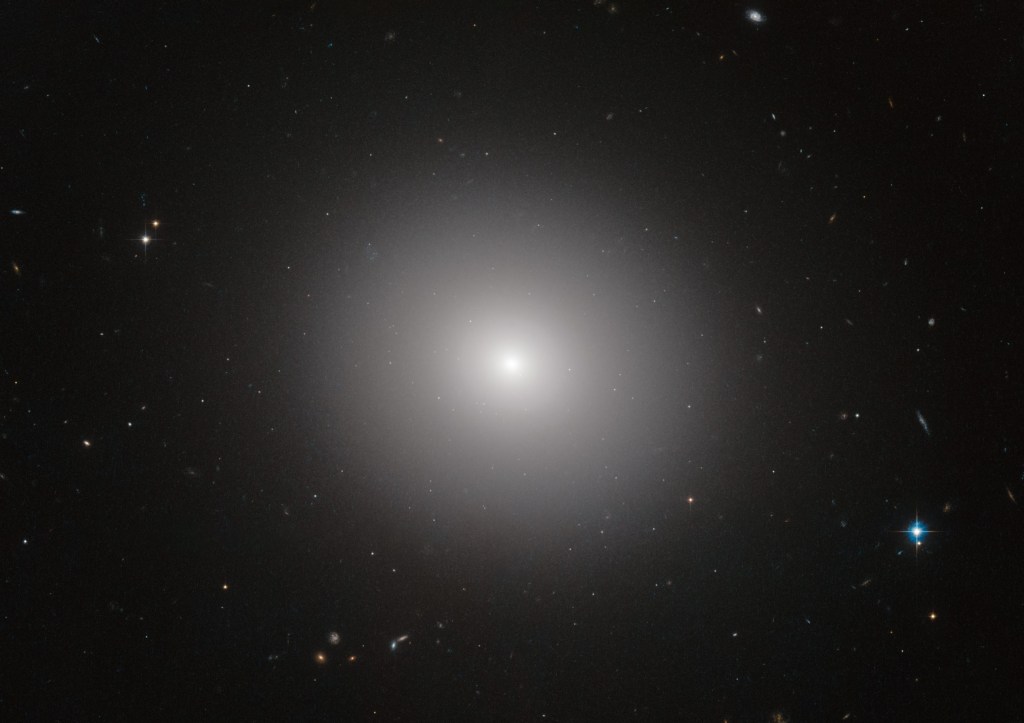
Today, many of the galaxies in the cosmos are old, impotent, red, blobish galaxies. Their spiral structure has long been destroyed, and their gas has been either used up or blown away, leaving little opportunity for new stars to be born. The Milky Way is an exception to the trend, still blue and dusty and giving birth to three or so stars a year, but she, too, will grow older and redder with time. The stellar birthrate in the Universe will eventually fall to near zero, but don’t worry, we have a looooong time to go!

Superclusters
As galaxies dance and the Universe expands, the galaxies themselves start to cluster, forming neighborhoods of giants bound together by their mutual gravity.
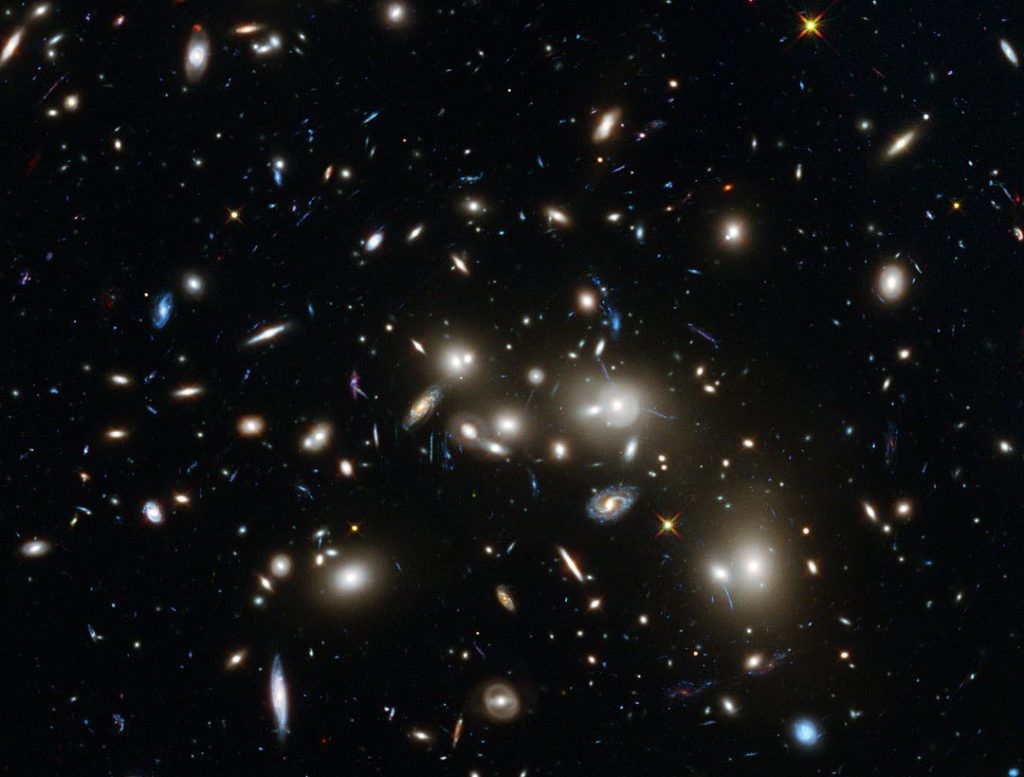
Although they look like disconnected, all these galaxies are actually swimming in a shared sea of dark matter, mysterious, ethereal stuff that makes up 90% of the clusters’ mass. Dark matter doesn’t seem to interact much with regular matter, instead passing straight through it. It does have mass, however, and it makes its presence known by its gravitational pull. In fact, its enormous weight is so strong that it even bends the light around the clusters like a great cosmic lens.

These clusters are not totally isolated from one another either, but are in a filamentous sort of web where one clump is connected to the next by tendrils of dark matter, gas, and galaxies. In between are enormous voids of empty, intergalactic space.
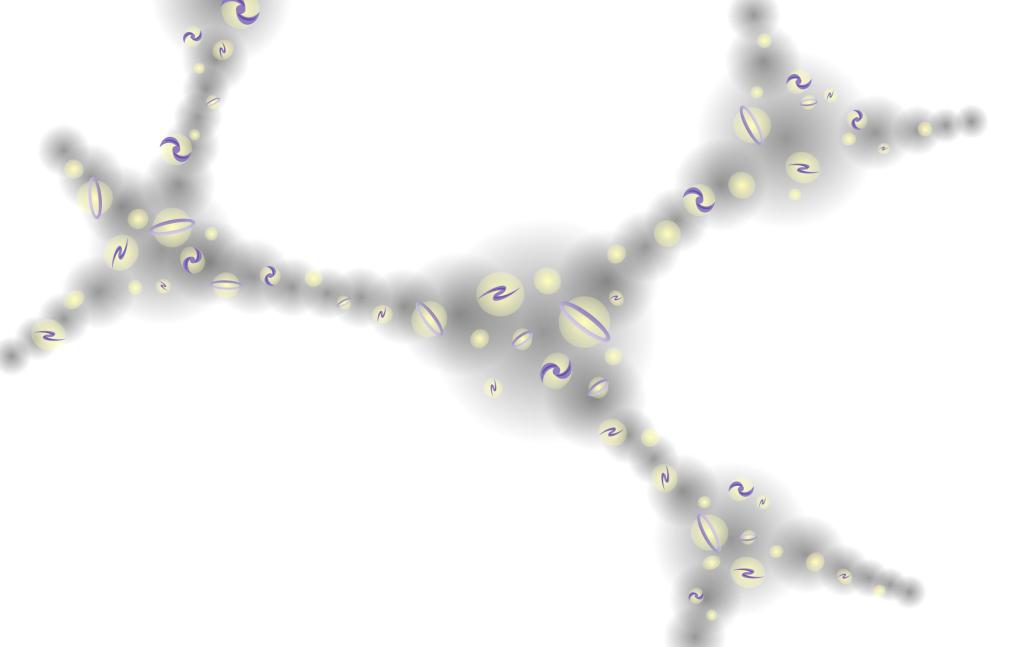
On the largest scale, the filaments and nodes seem to form a fractal foam kind of like the veins in your body, the inside of bread, or the neurons in your brain.

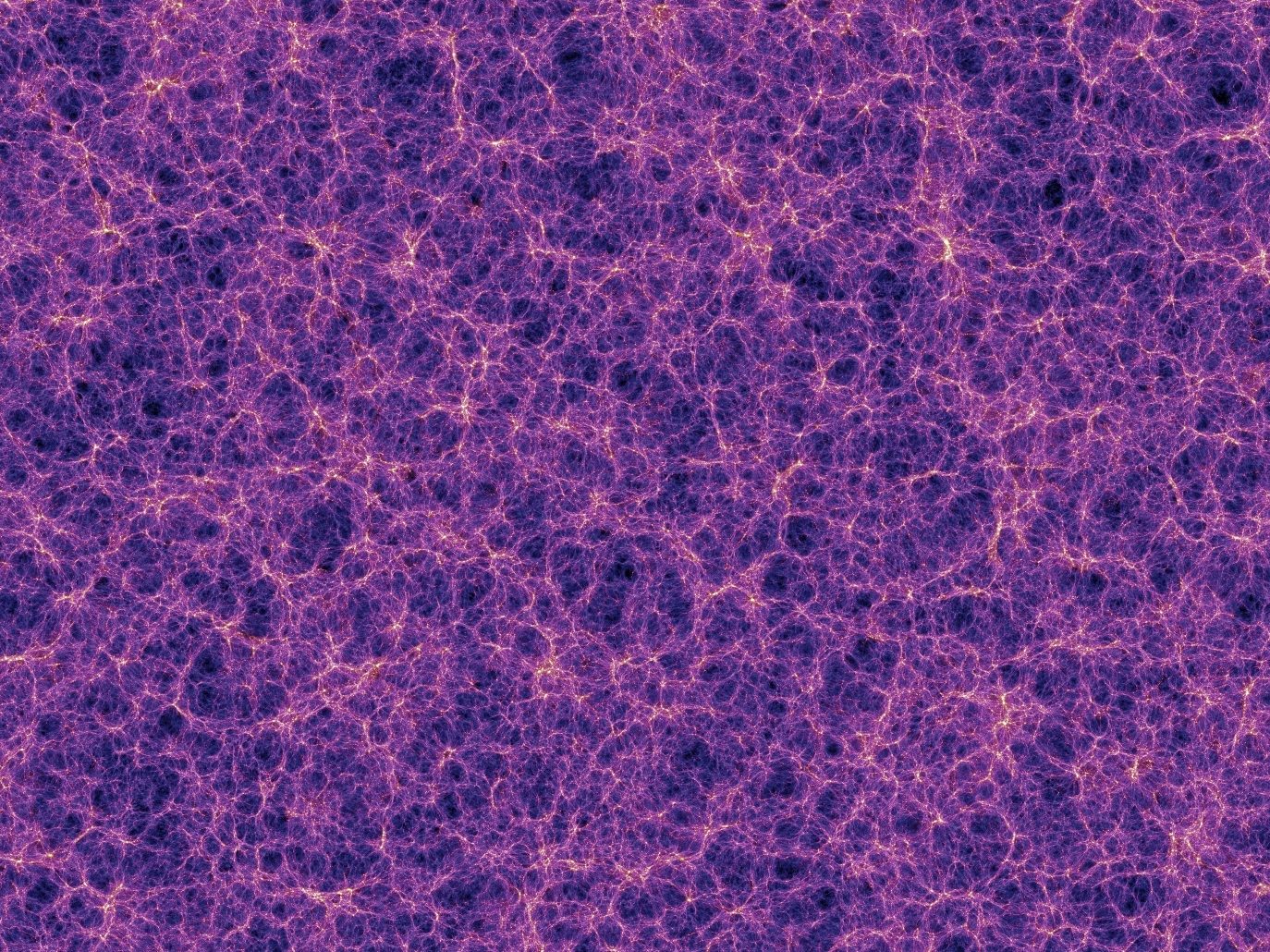
This is the the largest scale of the Universe that we can measure or even comprehend. Anything larger is beyond what can be observed from our vantage point here on Earth.
Each filament of this vast network contains thousand of galaxies, and each galaxy contains billions of stars harboring billions of planets. For eons, each star system experiments in different corners of the Universe with what it means to exist.

The Milky Way’s Spiral

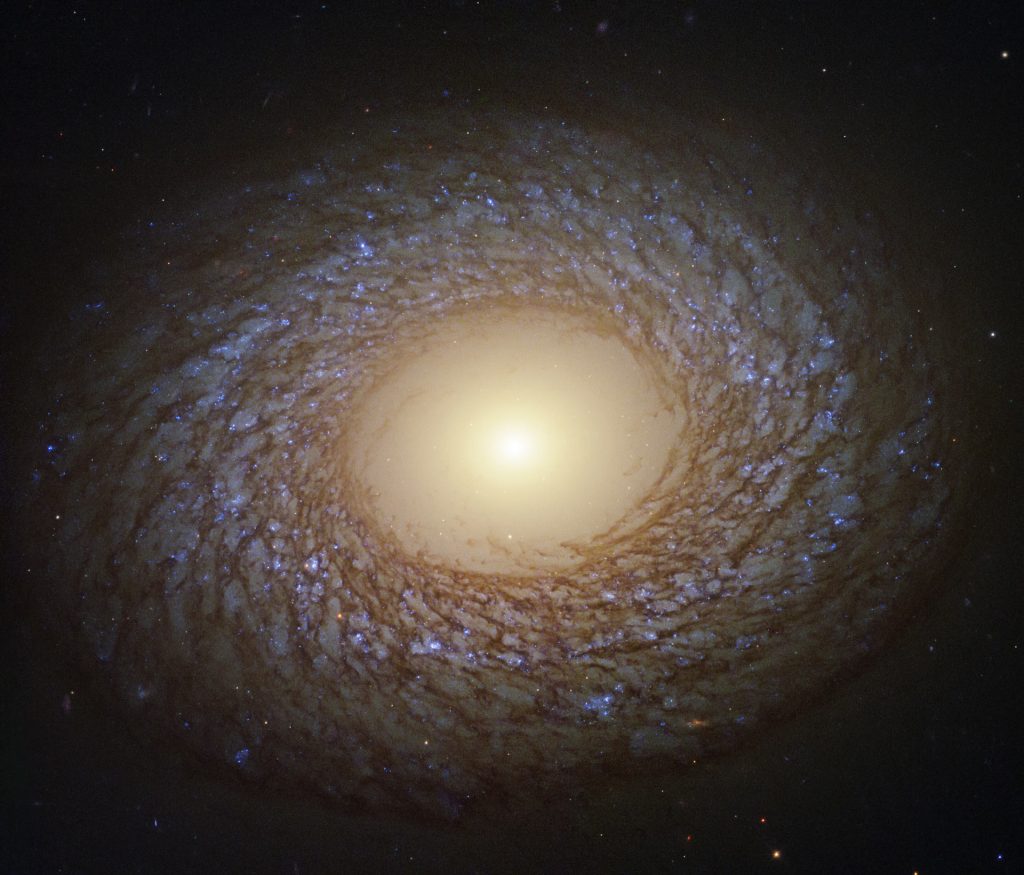
The Milky Way and the many galaxies like it take a while to reach their current state of maturity. As things continue to calm down and collisions happen less often, these galaxies become thinner and finer in structure compared to the more chaotic spirals that existed before. Some of them settle down enough that their spiral waves reach their lowest resonance of just two great spiral arms perpetually circling in their cycle of creation and destruction.

This bead represents the last major event in the Milky Way’s formation. Many of the stars in the thin disk of the Milky Way date to around this time, suggesting that they formed after the last large shake-up that the galaxy experienced.

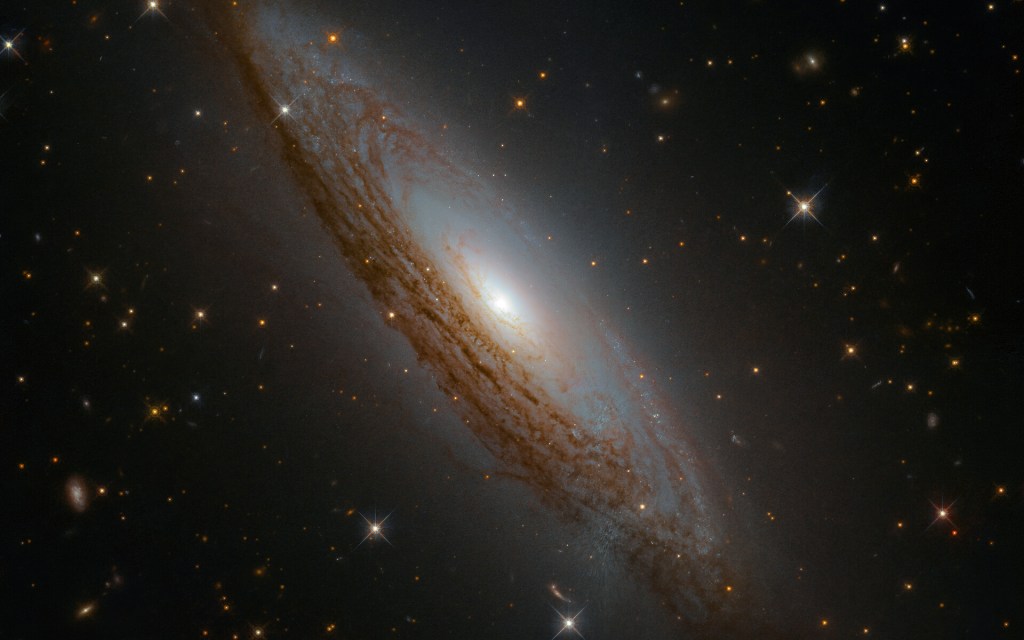
A galaxy that we see edge-on


The Birth of the Solar System
In a nebula rich in dust and ice in one of the Milky Way’s arms, a stellar chaos wheel forms alongside many sisters. As it spins and contracts, the center of this enormous disk becomes denser and hotter and begins to glow. Intense electromagnetic fields cause jets of plasma to erupt out either side like blazing astral fountains, giving the disk an axis, and making the whole ensemble look something like a spinning top. Clumps form in the disc and gobble up material, competing with one another to grow the biggest. The first to form takes the lion’s share of gas and sinks to the center of the disk. The next biggest clumps fight over the scraps and eventually become Jupiter and Saturn. All of a sudden, the clump of hydrogen at the center of the disc ignites into nuclear fire and our Sun is born. Solar wind then blows the excess gas away, and the combined stellar winds of the Sun and its newborn sisters slowly blow apart the larger nebula.

The jets of stars in process of formation, shrouded by their parent nebula

The Birth of Earth
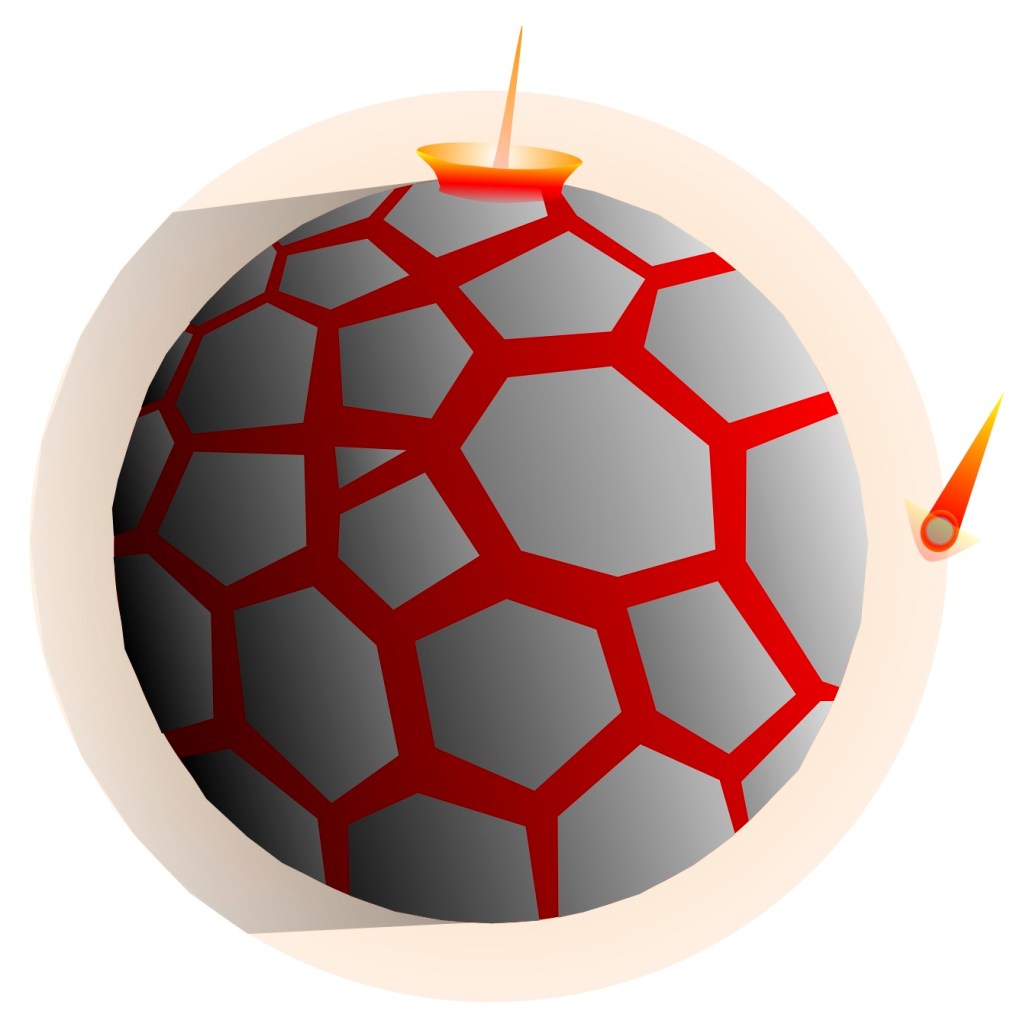
As things begin to calm down in the new solar system, dust and rocks in the Sun’s disk start to stick together, creating larger and larger chunks. These form belts of lumpy asteroids and eventually a handful of rocky planets. In the still chaotic disk, these planets are constantly pummeled by huge asteroids, heating them up until they are giant spherical droplets of liquid stone hurling around the sun. In this way, the Earth and her siblings are born.

The Birth of the Moon

For a while, the solar system settles down, and the Earth begins to cool off and form a crust. Unfortunately for the young Earth, not every planet in the system has chosen its own lane, and Earth is quite rudely interrupted by a small planet suddenly slamming into it. Both planets are immediately reliquified, and megatons of magma are slung out into space, forming a messy ring of stone globs orbiting the combined planets. Over millennia, the globs in this ring either fall back to Earth or eventually coalesce together to form the Moon.
The Moon has been slowly receding from us ever since. Because it was much closer to Earth back then, its tidal force was much greater. Imagine tides of lava a kilometer high circling the liquid Earth.

The Deluge
The Earth again sets to cooling and the vast ocean of lava again starts forming a solid crust, kind of like the skin that forms on the top of thick, hot soup. The number of large rude meteorites tapers off, and magma is banished to the underworld, only rearing its head in the many active volcanoes that dot the now rocky surface of the planet. The atmosphere is thick, toxic, and steamy as those volcanoes belch water and other volatile compounds from the depths of the planet.
Standing on the surface in a spacesuit, it would be impossible to make out the stars or even the Sun because the sky is so thick and hazy. If you poured a glass of water on the ground, it would immediately boil.
Eventually, the planet cools enough that water starts to condense into clouds, and one day it begins to rain. At first, the raindrops fall and sizzle on the ground, but the rain persists and puddles begin to form. Puddles become lakes, and lakes become great seas that fill the scars left by meteorites from the Earth’s recent past. It rains and rains for millions of years, and the whole world is enveloped in one global ocean.

The story of the young ocean planet continues here.